A Shift in the Business Model
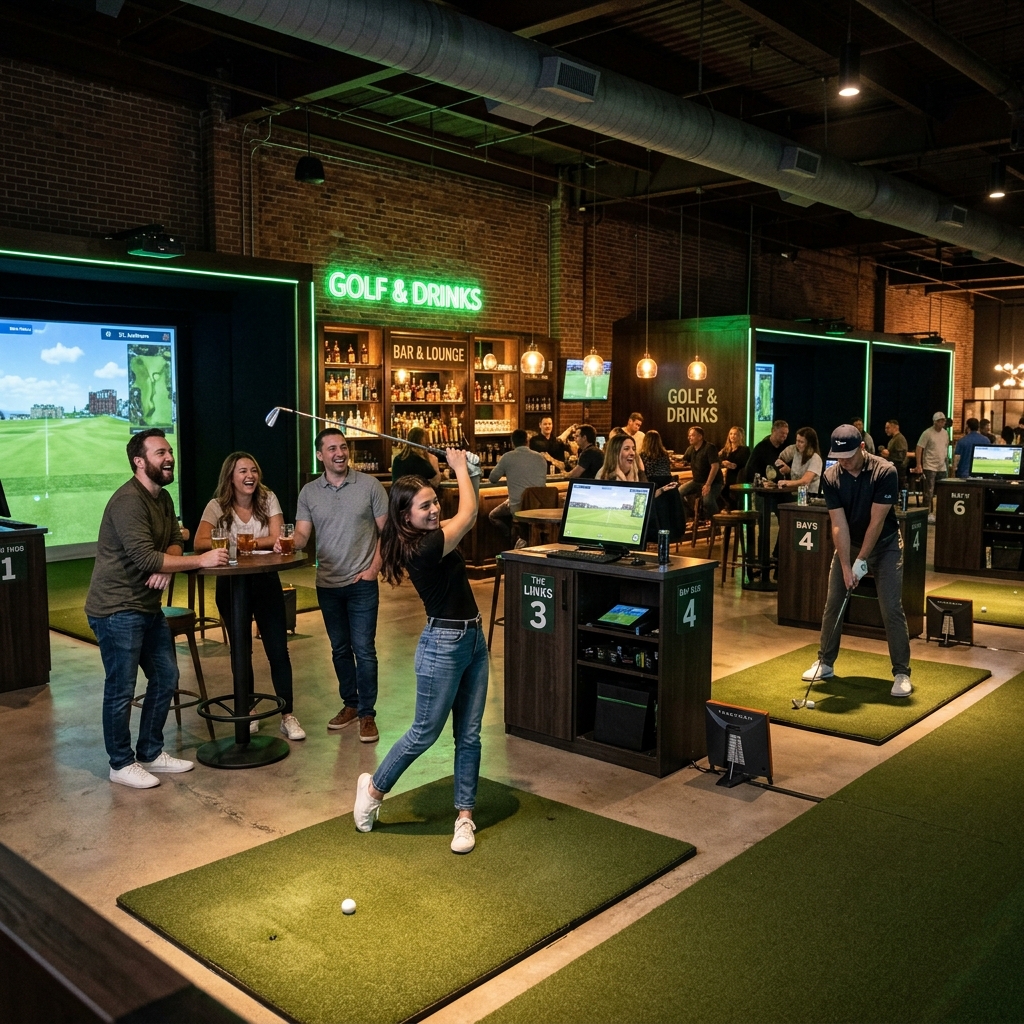
The traditional driving range model has been the backbone of golf practice for decades. But the economics are changing. Land costs are rising, weather dependency limits operating days, and the customer experience hasn't evolved in meaningful ways. Meanwhile, indoor golf simulator venues are emerging as a compelling alternative — not just for golfers, but for investors and operators looking at unit economics.
Revenue Per Square Foot
A Bay24 simulator bay occupies approximately 200 square feet. When operated 24/7 at industry-average occupancy rates, a single bay generates significantly more revenue per square foot than most retail or hospitality concepts. The key drivers:
- 24/7 Operation — Unlike traditional ranges that close at dusk, simulator bays generate revenue around the clock. Late-night sessions (10 PM – 2 AM) are surprisingly popular and represent pure incremental revenue.
- Weather Independence — Rain, snow, extreme heat, and darkness have zero impact on operations. This eliminates the seasonality that plagues outdoor facilities, particularly in northern markets.
- Premium Pricing — Private bays with premium technology command higher per-hour rates than a bucket of balls at a range, and customers perceive stronger value.
- Ancillary Revenue — Food and beverage, advertising on kiosk screens, membership plans, and corporate events layer additional revenue on top of bay bookings.
Operating Costs
The Bay24 model is built around technology-enabled cost efficiency:
- Staffing — BayOS automation allows venues to operate with minimal staff during off-peak hours. Session management, payment processing, and customer access are fully automated. A typical Bay24 venue requires 60-70% less staff than a comparable entertainment venue.
- Maintenance — Simulator technology is remarkably low-maintenance compared to outdoor facilities. No turf management, no ball washing, no range picker operations, no weather damage repair.
- Real Estate — Simulator venues can operate in existing commercial spaces — strip malls, industrial parks, mixed-use developments. No need for large land parcels or special zoning for outdoor recreation.
The Payback Period
Bay24 franchise locations are averaging under 14 months to full investment payback. This is driven by the combination of high revenue density, low operating costs, and the technology infrastructure that BayOS provides from day one. Franchisees receive a turnkey buildout package that includes all simulator hardware, BayOS licensing, kiosk systems, and Swing Lab camera installations.
Customer Retention
Indoor golf venues also benefit from stronger customer retention than traditional ranges. Bay24 membership data shows that members who join in their first month of visiting maintain an average subscription length that exceeds industry benchmarks for fitness and entertainment memberships. The combination of tracked progress (via Swing Lab), social features, and consistent availability creates strong habit formation.
The question isn't whether indoor golf will grow — the demographics, economics, and technology trends all point in the same direction. The question is which operators will build the technology infrastructure to scale efficiently.
Looking Ahead
The indoor golf market is projected to continue its growth trajectory as simulator technology becomes more accessible and consumer awareness increases. Bay24 is positioned at the intersection of this market growth and the operational efficiency that technology-first operators need to achieve sustainable margins. For operators interested in the franchise opportunity, we encourage exploring our franchise information page.